
Deed Types in Clinton County Records
Deeds, mortgages, liens, and similar legal instruments all live in the Clinton County Clerk/Register of Deeds. Each type does different work. A deed records a conveyance or a claimed interest in Clinton County property records. Other instruments burden, release, or clarify that interest. To read a record correctly, look past the label alone. The named parties, the legal description, the execution date, and the recording reference all matter just as much as the document type itself.
| Deed Type | What It Does | Common Use |
|---|---|---|
| Warranty deed | Conveys the stated interest with title covenants | Ordinary purchase conveyances |
| Quitclaim deed | Conveys whatever interest the grantor has, if any | Family, marital, or title-cleanup transfers |
| Trustee or fiduciary deed | Conveys through a trust or authorized representative | Trust and estate administration |
| Executor or administrator deed | Documents a probate-authorized conveyance | Estate property sales |
| Tax-related conveyance | Records a transfer arising from the statutory tax process | Delinquent-tax property history |
One caution is worth repeating. A mortgage or a lien is not a deed in any form. It records an encumbrance or claim against the property. A later release or discharge may be needed to know where that claim stands. The index itself is only a finding aid. It points you to the image and any related filings.
Search Fields in the Clinton County Deed Index
Clinton County runs a free self-service deed index through a Tyler-hosted search. Viewing, buying, or printing documents takes a registration and a login. A few habits make a property search go faster. Search one party role at a time. Narrow by document type and date where you can. Jot down the recording reference before opening any image. The official county index page spells out the public access route. It also covers where deed records reach.
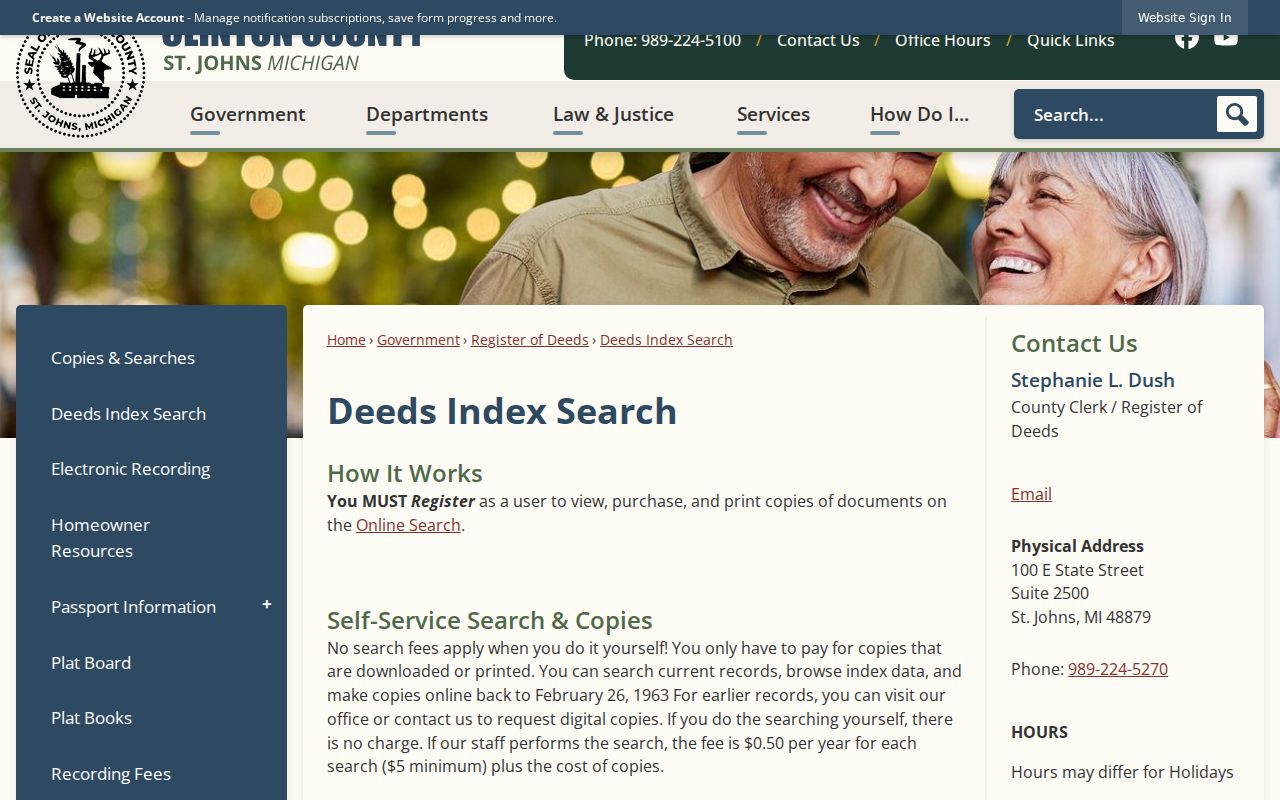
Note: Read the county page together with the separate live-portal warning about limited search fields for records dated before December 15, 1965.
| Index field | How to use it | Why it matters |
|---|---|---|
| Grantor | Search the person or entity conveying an interest | Moves forward from a prior owner |
| Grantee | Search the person or entity receiving an interest | Locates an acquisition deed |
| Document type | Narrow deeds, mortgages, liens, releases, or easements | Separates transfers from encumbrances |
| Document and recording dates | Bracket a known transaction period | Distinguishes signing from recording |
| Instrument or book/page | Retrieve a known filing directly | Provides a durable citation |
Clinton County's 1964 and 1965 Index Boundary
Clinton County advertises online copies reaching back to June 19, 1964. A separate notice on the live portal adds a caution. Records dated before December 15, 1965 hold only limited fields. These are recording date and time, document type, document date, grantor, and grantee. The two dates measure different things. One sets the depth of available copies. The other warns that searchable detail thins out earlier than the copy cutoff.
Note both boundaries in any research log you keep. The deed records you need may fall before the useful online fields. Ask the office directly about microfiche, deed books, or other on-site help. The official sources publish no complete first-volume range. They also give no full pre-1964 finding aid for Clinton County property records.
Follow Clinton County Legal Descriptions, Not Just Streets
A street address can change. The legal description in a deed is what ties a transfer to the land itself. Platted parcels usually cite a subdivision, a lot, and sometimes a block. Rural property leans on section, township, range, bearings, distances, acreage, and monuments. A split can rewrite the description. Carry both the parent and child parcel references into your next property search.
Old chains benefit from county-linked atlases and plats. These bridge modern and historic geography. The Library of Michigan Clinton guide points to an 1873 county atlas, plus an 1896 atlas with plats. It also lists a 1930-39 W.W. Hixson plat book. And it includes the 2008 Family Maps volume. These aids help you locate the land. The recorded deed remains the true conveyance source for Clinton County property records, whatever the plat shows.
Old Clinton County Drain Rights-of-Way
Rural deed research in Clinton County carries a local exception worth a check. Older drain rights-of-way, dating before 1993, may sit in the index under the drain name and county rather than where a modern parcel query would suggest. A parcel-number-only deed search can therefore look complete while missing records that are actually there.
Use the drain name. Compare the FetchGIS Drains layer with the county drain reference, then ask the recorder about office microfiche for pre-1993 material.
Historic Context for Clinton County Deed Records
Clinton County was created in 1831 and organized in 1839. The courthouse history records an important gift from St Johns. Residents later raised $2,000. They also supplied a 1.5-acre building site. County offices moved from DeWitt to Plumstead Hall in December 1857. A brick county building followed in 1858.
Those moves shaped the county's early paperwork. That is why early deed records reference DeWitt, St Johns, Plumstead Hall, Newton Hall, or the Hicks building. They do not mean the recorder lost anything. No official account reports a courthouse fire destroying the county's deed books. DeWitt's documented 1930 downtown fire should not be stretched into such a claim.
Monitor New Clinton County Recorded Activity
Clinton County's recorder provides a free watch service called Fraud Guard. Sign-up happens after deed-search registration. From there, a user monitors a name. The user gets an email whenever that name shows up on a newly recorded document in Clinton County. Mortgages, liens, construction liens, and other property activity are the kinds of filings it flags.
The Fraud Guard registration page describes a monitoring tool, not a block on recording.
When an alert arrives, check the instrument number and pull the recorded image. An alert never halts recording, fixes an instrument, or rules on whether a filing is valid.
Request Clinton County Deed Copies Four Ways
The Clerk/Register of Deeds accepts copy requests in person, by mail, fax, and email. The office is at 100 E State Street, Suite 2500, St Johns, MI 48879; rod@clinton-county.org; 989-224-5270. Published hours are Monday through Friday, 8 a.m. to noon and 1 to 5 p.m., with arrival by 4:30 recommended.
The current fee page lists real-estate copies at $1 per page and certification at $5 per document, with the whole document copied. A name search costs $0.50 per year with a $5 minimum; a plat copy is $2. The older request PDF says fax or email adds $3 and cannot deliver certified copies. Use the current fee page to verify the total before sending payment, while following the form's requested name, contact, document, delivery, and certification fields.
Walk the Clinton County Grantor-Grantee Chain
The index runs on party names. Start from the newest deed you trust. Then work backward through the seller's own acquisition in Clinton County. At every step, compare the legal description, document type, date, and recording reference. That keeps two same-name parties or two nearby tracts from collapsing into one false chain.
- Find the most recent acquisition deed with the current named party as grantee.
- Read the grantor and exact legal description from the image, not just the result row.
- Search that grantor as a grantee to locate the deed by which that party acquired the same land.
- Repeat while matching subdivision, lot, block, section, parcel, and recording references.
- Move to office and microfiche research when the online fields no longer support the chain.
- Grantor
- The party conveying the stated interest.
- Grantee
- The party receiving the stated interest.
- Chain of title
- The linked sequence of recorded conveyances for the same land.
- Book/page and instrument number
- Two forms of citation used to identify a recorded document.
Get a Clinton County Deed Copy
Try the online image route first. The deed should fall within available coverage, and the account must be able to retrieve it. For a certified copy, older material, an uncertain reference, or a failed portal session, send the full instrument information to the Clinton County Register of Deeds. You can also visit the counter. Staff will search and provide copies. They cannot draft or amend a deed, offer legal advice, or hand out blank forms.
Recorded does not mean guaranteed. Clinton County deed records show filed instruments; they are not a title opinion and cannot rule out unrecorded interests or competing claims.