
Trace Former Clinton County Owners Through Each Era
A former-owner history runs backward. Begin at the newest recorded conveyance and keep the legal description in view at every step. Clinton County offers more than one trail. The online index, document images, office microfiche, plats, and historical references each cover different periods and answer different questions. The deed index controls the starting point for transfers. Plats and atlases interpret an old description, while newspapers can explain a sale notice or a changing place name. None of them replaces the recorded instrument itself.
| Transfer Date | Grantor to Grantee | Deed Type | Book/Page or Instrument |
|---|---|---|---|
| Newest recorded transfer | Prior holder to current grantee | Copy the indexed type | Record the exact reference |
| Next earlier transfer | Earlier holder to prior grantee | Verify from the image | Match the legal description |
| Mid-1960s link | Continue through both party roles | Use available index fields | Test image access against both cutoff notices |
| Earlier book entry | Continue one owner at a time | Do not infer the form | Use office microfiche and deed books |
For a recent transfer, start online. Work near the mid-1960s boundary means preserving both county notices. Check whether an image truly exists. Earlier chains need the Register of Deeds. Bring names, an approximate span, and the legal description. The county publishes no first deed-book year and no complete shelf inventory. Treat any claim about the oldest surviving volume with caution.
Start the Clinton County Chain With the Latest Grantee
Anchor the search to the newest deed. Use the county assessing route or FetchGIS to get the parcel identification number and the legal description. Then search the recorder index for the current owner as grantee. The assessor name is a useful lead. Note which system supplied it. Displays do not all update at the same moment, so the recorded deed remains the authority.
Keep the parcel constant. A street label can change, but the legal description, instrument reference, and parcel key let you test whether two names belong to the same land.
From the acquisition deed, capture the recording date, document date, instrument number, deed type, grantor, grantee, and legal description. Those fields open your backward timeline. A sale amount may appear too. Treat it as event detail rather than proof of who came next in the chain.
Search Clinton County Grantors and Grantees Separately
Each name changes role as you move back. The person who acquired the parcel on one deed is the grantee. On the next earlier deed, that same person should appear as grantee again, with the prior holder as grantor. Search both roles. Compare descriptions as well. That discipline avoids following an unrelated same-name transaction elsewhere in Clinton County.
| Transfer Date | Grantor to Grantee | Deed Type | Book/Page or Instrument |
|---|---|---|---|
| Newest recorded transfer | Prior holder to current grantee | As indexed | Record exact reference |
| Next earlier transfer | Earlier holder to prior grantee | As indexed | Match the same description |
| Earlier book entry | Continue one link at a time | Do not infer | Use office finding aid |
Trusts, estates, companies, and joint grantees can change the name form without changing the parcel. Search variants with caution. The instrument image shows whether a trustee, fiduciary, or entity signed in a representative role.
Walk the Clinton County Deed Chain Backward
A repeatable chain keeps a written log. Move only after the land match is sound. The free self-service index requires registration or login to view, purchase, and print documents. Establish the chronology first. When an index line is ambiguous, consult the deed image. If the goal is a sequence of former owners rather than one certified copy, the index carries most of the load.
- Find the newest acquisition deed and verify its legal description against the subject parcel.
- Write down the grantor, who is the next former owner to research.
- Search that grantor as a grantee, then match the earlier acquisition deed to the same land.
- Repeat while recording every reference; when online detail ends, continue through the office and deed books.
- Grantor / grantee
- The conveying party and the receiving party named in an instrument.
- Chain of title
- The ordered sequence of recorded transfers affecting the same land.
- Reverse index
- An index organized to help trace parties by role and name.
- Warranty / quitclaim deed
- Different deed forms whose legal effect must be read from the recorded document, not guessed from the index label.
Reconcile Clinton County's Two Mid-1960s Cutoffs
Clinton County posts two mid-1960s cutoffs. Its Deeds Index Search page advertises online copies back to June 19, 1964. A separate recorder notice says records before December 15, 1965 carry only five index fields: recording date and time, document type, document date, grantor, and grantee. Official text never reconciles the two. Report both, then test the instrument you need.
This matters when a chain crosses 1964 or 1965. A name hit may exist without the full description or image needed to confirm the parcel. A blank online field is not proof that no transfer occurred. Ask the Register of Deeds to bridge that gap.
The county's Deeds Index Search page documents the public search route and the stated cutoff.
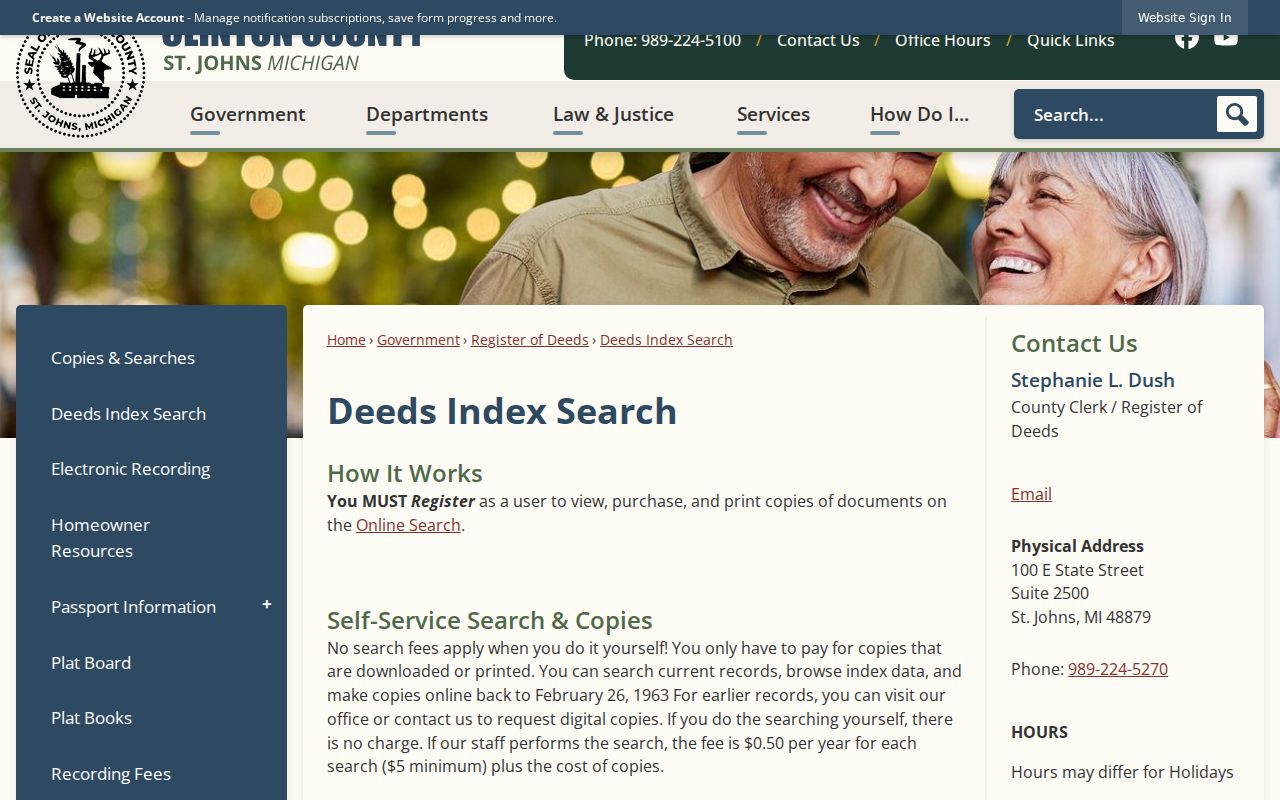
The image confirms the county landing page. The live portal warning supplies the limited-field date.
Follow Clinton County Legal Descriptions When Streets Change
Older deeds often name a section, township, range, lot, block, or subdivision instead of a modern street address. A split, combination, condominium plan, or replat can also make today's parcel ID a poor key for an earlier transfer. Preserve the exact description at each link. Note where it changes.
Recorded plats fix subdivision geometry. Historical atlases add period context. The Library of Michigan county guide points to atlases and newspapers, and the county links Historic Map Works. These sources bridge names and places. The deed remains the operative transfer record. Keep the source that suggested a connection separate from the recorded instrument that confirmed it.
Use Clinton County Probate Files to Explain a Broken Link
A clean seller-to-buyer chain sometimes stops at a death. The Clinton County Probate search can explain the gap. It may reveal an estate, a fiduciary appointment, an order authorizing sale, or a distribution. Any of those documents can explain a later deed. It may carry an executor, administrator, trustee, or beneficiary name instead of a familiar owner. Probate results may lag, though. True verification takes a court visit or a written request.
Remember that a death certificate alone never moves land. Go back to the Clinton County deed index. Look there for the executor deed, administrator deed, affidavit, trustee deed, or beneficiary conveyance touching the parcel. Match the legal description and parcel number first. Then add the event to your property records timeline. That discipline keeps probate authority and the recorded land transfer in their proper roles.
Read DeWitt and St Johns as Clinton County Search Clues
Clinton County's seat has not always sat in St Johns. It moved from DeWitt in 1857. St Johns residents raised $2,000 and supplied a building site. Early references may instead name Plumstead Hall, Newton Hall, or the Hicks building as the records setting. Those labels do not signal that a property changed counties. But they can clarify a historical notation or a newspaper notice you find in deed records research.
The official DeWitt history records a 1930 fire. It destroyed eight downtown buildings, including the Clinton House or Hotel. It makes no claim about county deed books. Use that event for downtown history and newspaper context only. Skip any invented records-loss story when tracing past owners.
Move Older Clinton County Work to Microfiche and the Office
When online details stop identifying the land, contact the Clinton County Clerk/Register of Deeds. The office sits at 100 E State Street, Suite 2500, in St Johns. It takes mail, fax, email, and in-person requests. Hours are weekdays, 8 a.m. to noon and 1 p.m. to 5 p.m., so aim to arrive by 4:30. Bring staff the names you have. Add a date span, instrument references, and the legal description you have already established.
One county notice offers a real gift for rural property records work. Drain rights-of-way before 1993 may be indexed by drain name and county. They may live on office microfiche. A parcel-number-only search can sail right past such an instrument, because that index route depends on the drain name. Pair the Drains layer in FetchGIS with the drain name first. Then ask the office about the older index route.
Know How Far Clinton County Ownership Records Go
The online boundary is documented. But the county does not publish the complete physical starting point or the deed-book volume ranges. A defensible former-owner timeline may therefore end at the oldest record staff can locate. It does not end at a guessed founding-year deed. Note the date you searched and the channel you used. Clinton County's 2026 budget objectives include continued back-indexing of older land records. So online depth can change over time.
Historical newspapers, plats, and atlases can stretch a property story past a convenient online chain. Label them as supporting evidence. For help obtaining one recorded instrument, see the Clinton County deed records page. This page's job is keeping the sequence of prior owners intact.
Use the record responsibly. Research past owners for title work, house history, or property diligence. Never use public records to track, threaten, or harass a living person.